
By Kelly Clancy, Screen Time Action Network Member
April ended not with a whimper, but a bang, as parents, teachers, and students took to the streets and to school board meetings to express outrage over the anti-democratic way that AI is being forced into schools.
In classrooms across New York City, it’s the Wild West of AI. The DOE allows any AI to be used in any classroom, preK–12, for any reason, as long as it meets dubious privacy standards. That’s why last year, we formed a coalition to demand a moratorium on AI in NYC public schools. Our ask is simple: no AI without protections that center student cognitive development and mental health, guard against the de-skilling of teachers, are honest about environmental impacts, and safeguard student privacy.
In the biggest school district in the country, we’re David, fighting a mega-Goliath of tech bros and entrenched bureaucracy.
We’re also winning.
Here’s what happened in the last week of April.
April 27: Chancellor Kamar Samuels canceled a proposal for an AI-themed high school (what elected officials have privately referred to as “an AI petri dish.”) The proposal would have forced the closure of a beloved community middle school, and it inspired deep resistance across the city. At the last second, the city blinked. Community advocates won.
April 29: Students, teachers, and parents poured into an old-school auditorium with creaky wooden chairs for the monthly PEP (Panel on Educational Policy) meeting. For seven hours, folks testified against AI in what Chalkbeat’s Lizzie Walsh coined “the AI rebellion.” We defeated a contract that bragged about personalized, AI-powered learning platforms for young children. Advocates stayed until 1 AM to make their voices heard — on a school night!
April 30: The rebellion continued in my neighborhood of south Brooklyn, where 60+ parents showed up at a meeting to voice their frustration over the city’s cavalier approach to AI. As Matt Steib captured in New York Magazine, parents are realizing that their kids as young as 5 are using AI without their consent — and they are fighting for a learning experience centered on play, not screens.
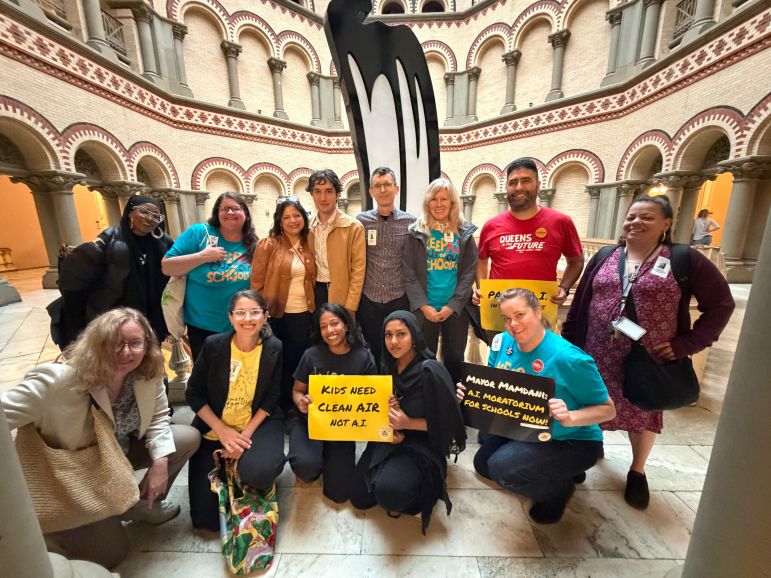
Lessons from inside the rebellion:
—We’re winning. There’s no doubt that the national conversation around EdTech in general, and AI in particular, has shifted. Parents across the country are realizing that Silicon Valley billionaires, not teachers, are making decisions about how their kids learn, and they’re mad.
—The fight is intersectional. As Liat Olenick of Climate Families NYC says, “This is the fight of our time. We’re not going to subject children to this experiment which will leave them a world on fire.”
The strength of our movement lies in bringing together folks concerned with climate, racial justice, education equity, distraction-free schools, privacy, and other issues. This comes along with a healthy disagreement over tactics and strategies, but also a wealth of networks, connections, and wisdom.
—The risks are not evenly distributed. Advocates love to frame AI as an equity issue. We agree. As one high schooler testified at the PEP meeting, AI is part of the school-to-prison pipeline; Dr. Kaliris Salas-Ramirez, a neuroscientist and member of Racially Just Public Schools, argued that white families have the power to opt out and keep their kids away from these technologies, whereas Black and Brown kids are forced to engage with them. And as one dad who has a child who uses an assistive communication device told me, children with disabilities are often used as a justification for AI rollout, when in reality they are the children most likely to be forced onto screens all day as babysitters. The risks are not equitably distributed, instead accruing to our most vulnerable kids.
—First steps: Change is possible everywhere: if a few of us can move the needle in NYC, imagine what’s possible in your area. Start by asking questions — what’s going on in your school? Is your teacher or principal an ally? What’s happening on the district level? Finding likeminded parents can be helpful, and often that starts by just bringing up topics at community meetings.
Parental engagement is not the same as shared governance: insist on your right to be heard, find the places where decisions are being made and who holds the power, and then become part of those spaces. I founded PACES because I couldn’t find information parents needed to understand AI in schools — luckily, that’s not the case anymore.
I was proud to help pen Fairplay’s AI pause position statement calling for a five-year pause on AI — you too can join your voice with parents and experts from around the world by signing the petition. Fairplay is at the forefront of a national movement to change how we think about EdTech, and it’s inspiring to see hundreds of parents across the world feeling empowered to make this change.
Soon after our busy week, the AIM Coalition was invited to meet with the New York City Schools Chancellor Kamar Samuels and members of his team. We delivered our demand for a two-year moratorium, our petition signed by thousands of NYC parents, Fairplay’s coalition letter, and testimony from parents and educators. We look forward to continuing our conversations with him, and we’re optimistic that we can kick September off with a full moratorium on AI.

Kelly Clancy is the mom of three kids in Brooklyn. She is the founder of Parents for AI Caution, which is a member of the Coalition for an AI Moratorium in NYC Schools and sits on the Community Education Council for District 20. She is a writer and editor, and the author of “Democracy: A Love Letter (and a guide for everyone fighting to save it).” Kelly is a member of Fairplay’s Screen Time Action Network and the Screens in Schools Work Group.