
Help protect kids from online harms!
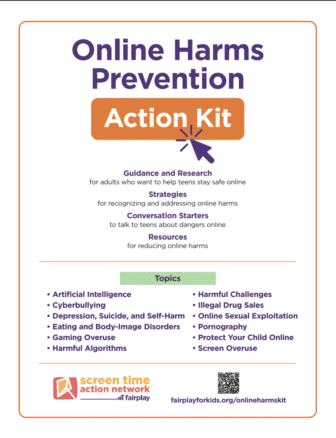
Our Online Harms Prevention Action Kit provides:
- Guidance and research for adults who want to help teens stay safe online
- Strategies for recognizing and addressing online harms
- Conversation starters to talk to teens about dangers online
- Resources for mitigating online harms
Want to get more involved? Learn more about the Screen Time Action Network and join today!
The Action Kit was created in response to feedback from advocates and practitioners seeking research-based education and advocacy materials that are easy to use and distribute. This collection of free, downloadable resources answers that call! We hope our Action Kit serves as a practical and helpful tool to support families and mental health practitioners. We would love your feedback!
To download the entire Action Kit, click here.
Artificial Intelligence Harms: The negative consequences or risks that arise from the development, deployment, or use of artificial intelligence systems.
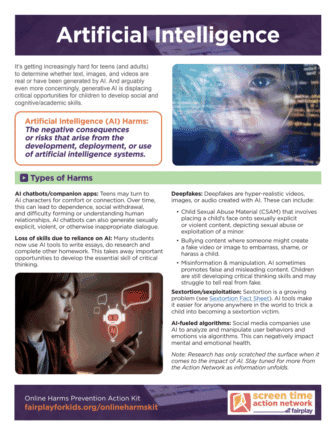
Learn More about Artificial Intelligence Harms:
Cyberbullying: The use of digital devices (cellphones, gaming consoles, computers, or tablets) to send, post, or share threatening, mean, intentionally embarrassing, or false information to someone either privately or publicly online.
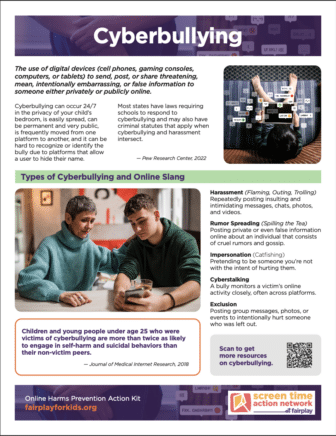
Learn More about Cyberbullying:
Depression: Persistent sadness and hopelessness.
Self-harm: Hurting oneself on purpose to deal with painful emotions without the intent to end one’s life.
Digital self-harm: Posting insulting or disparaging comments about oneself online/on social media.
Suicide: Deadly violence directed at oneself with the intent to end one’s life.
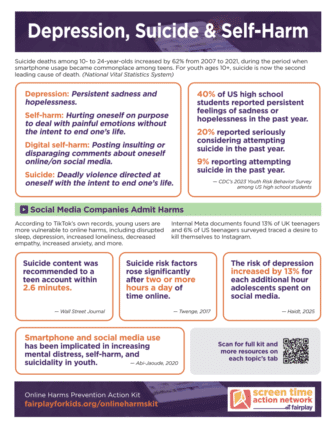
Learn More about Depression, Suicide, and Self-Harm:
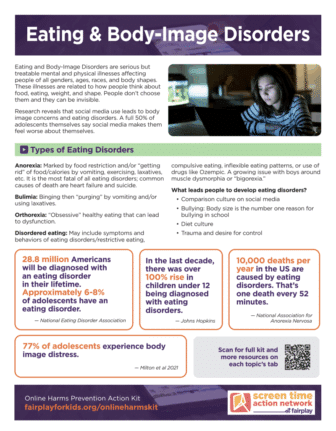
Eating Disorders: Eating and Body-Image Disorders are serious but treatable mental and physical illnesses affecting people of all genders, ages, races, and body shapes.
Learn More about Eating Disorders:
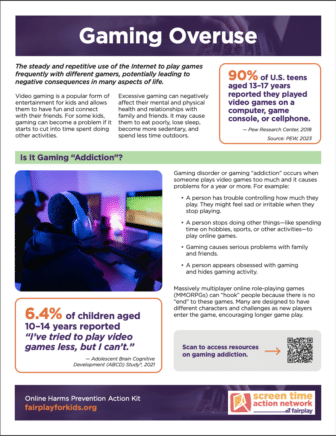
Gaming Overuse: the steady and repetitive use of the internet to play games frequently with different gamers, potentially leading to life negative consequences in many aspects of life.
Learn More about Gaming Overuse:
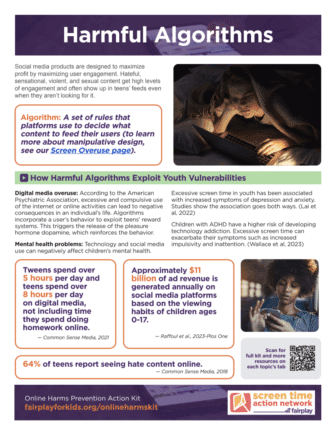
Algorithm: A set of rules that platforms use to decide what content to feed their users (to learn more about manipulative design, see our Screen Overuse page).
Learn More about Harmful Algorithms:
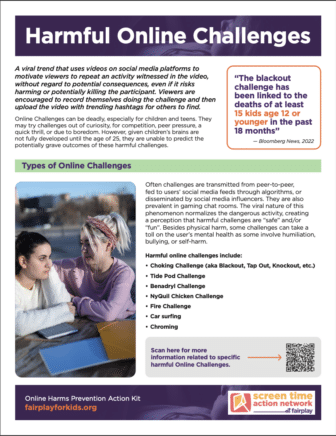
Harmful Challenges: A viral trend that uses videos on social media platforms to motivate viewers to repeat an activity witnessed in the video, without regard to potential consequences, even if it risks harming or potentially killing the participant. Viewers are encouraged to record themselves doing the challenge and then upload the video with trending hashtags for others to find.
Learn More about Harmful Online Challenges:
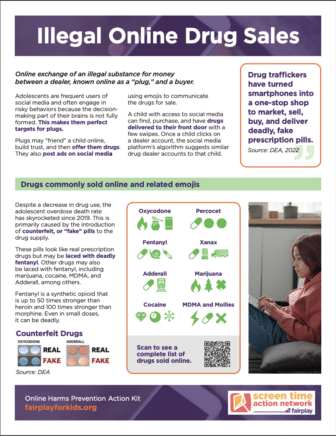
Illegal Online Drug Sales: Online exchange of an illegal substance for money between a dealer, known online as a “plug,” and a buyer.
Learn More about Illegal Online Drug Sales:
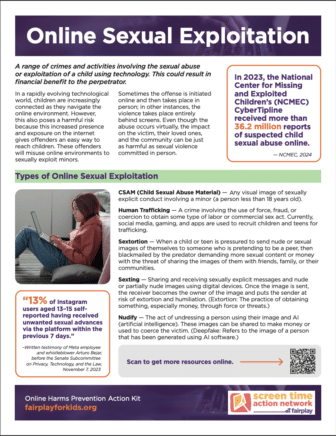
Online Sexual Exploitation: A range of crimes and activities involving the sexual abuse or exploitation of a child using technology. This could result in financial benefit to the perpetrator.
Learn More about Online Sexual Exploitation:
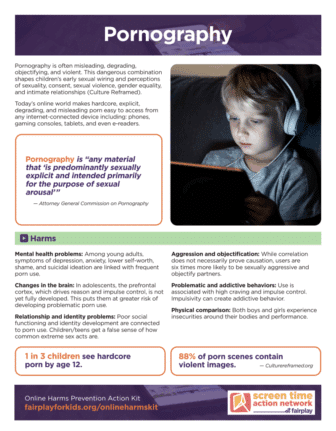
Pornography: any material that ‘is predominantly sexually explicit and intended primarily for the purpose of sexual arousal.
Learn More about Pornography:
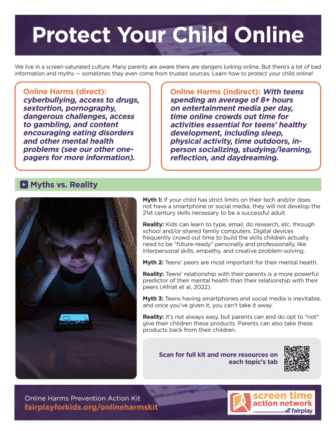
Online Harms (direct): Cyberbullying, access to drugs, sextortion, pornography, dangerous challenges, access to gambling, and content encouraging eating disorders and other mental health problems (see our other one-pagers for more information).
Online Harms (indirect): With teens spending an average of 8+ hours on entertainment media per day, time online crowds out time for activities essential for teens’ healthy development, including sleep, physical activity, time outdoors, in-person socializing, studying/learning, reflection, and daydreaming.
Learn More about Protecting Your Child Online:
- Social Dilemma
- Reset Your Child’s Brain
- Dr. Adriana Stacey on Screen Addiction (#135)
- Surgeon General Advisory
- Relationship quality and mental health implications for adolescents during the COVID‑19 pandemic: A longitudinal study
- Maternal, paternal, and peer relationships differentially predict adolescent behavioral problems
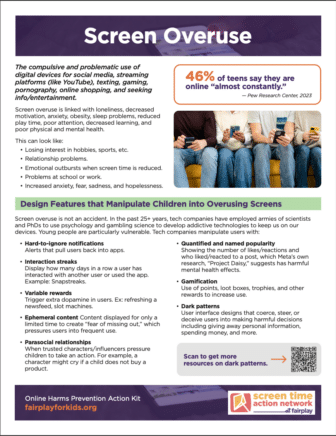
Screen Overuse: The compulsive and problematic use of digital devices for social media, streaming platforms (like YouTube), texting, gaming, pornography, online shopping, and seeking info/entertainment.
Learn More about Screen Overuse:
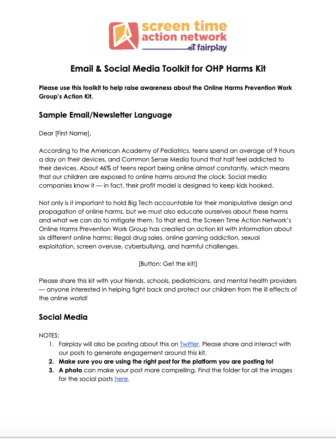
Want to help spread the word? Download our promotional toolkit and flyer today to help share these important materials!
Thanks to all who have contributed to the development and launch of the Action Kit!
Special appreciation to: Julianna Arnold, Kristin Bride, Derek Campbell, Rebekah Cole, Lynn Creasy, Laura Derrendinger, Jen Doty, Eric Feinberg, Maree Hampton, Brett Kennedy, Annie McGrath, Maurine Molak, Amy Neville, Lauren Paer, Neveen Radwan, Jean Rogers, Judy Rogg, Peter Ryan, Deb Schmill, Joni Siani, Vinaya Sivakumar, Meghan Stuhmer, Ashwin Verghese, Liana Vincent, Dawn Wible, Liz Willers, and Sharon Winkler.

The Online Harms Prevention Action Kit was brought to you by Fairplay’s Screen Time Action Network. Our Screen Time Action Network is a coalition of practitioners, educators, advocates, and parents working to promote a healthy childhood by reducing the amount of time kids spend with digital devices. Membership to our network is free. Join today to become a part of our community!