
Learn how to stay safe online!
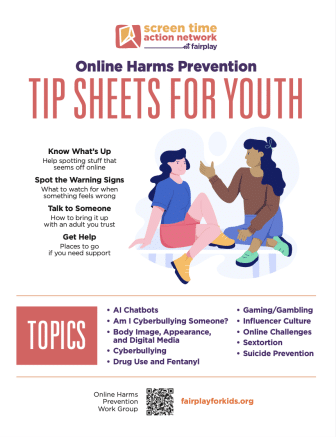
Our Teen Online Harms Prevention Action Kit encourages young people to:
- Know What’s Up: Help spotting stuff that seems off online.
- Spot the Warning Signs: What to watch for when something feels wrong.
- Talk to Someone: How to bring it up with an adult you trust.
- Get Help: Places to go if you need support.
These Tip Sheets were created in response to feedback that teens and young adults — the ones immersed in the online world and its dangers — desired an online harms action kit of their own to help them stay smart and safe online. This collection of free, downloadable resources answers that call! We hope our Tip Sheets serve as a practical and helpful tool to support youth, families, educators, and mental health practitioners. We would love your feedback.
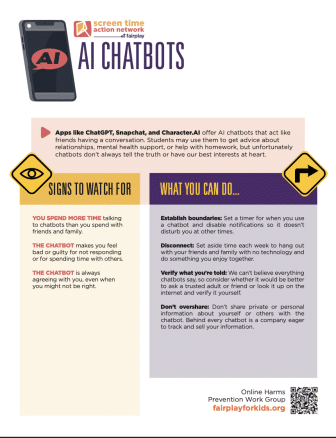
AI Chatbots: Apps like ChatGPT, Snapchat, and Character.AI offer AI chatbots that act like friends having a conversation. Students may use them to get advice about relationships, mental health support, or help with homework, but unfortunately chatbots don’t always tell the truth or have our best interests at heart.
Get Help Now:
- NAMI Teen & Young Adult Helpline — call 1-800-950-NAMI (1-800-950-6264) or text Friend to 62640 (Mon-Fri, 10am-10pm ET)
- 988 Suicide & Crisis Lifeline — call or text 988 for immediate mental health or substance use crisis support (free, confidential, 24/7)
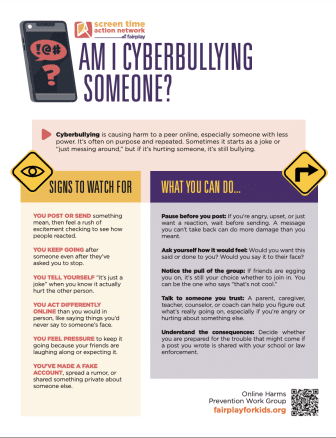
Am I Cyberbullying Someone? Cyberbullying is causing harm to a peer online, especially someone with less power. It’s often on purpose and repeated. Sometimes it starts as a joke or “just messing around,” but if it’s hurting someone, it’s still bullying.
Get Help Now
- StopBullying.gov
- Crisis Text Line — text HOME or HOLA to 741741
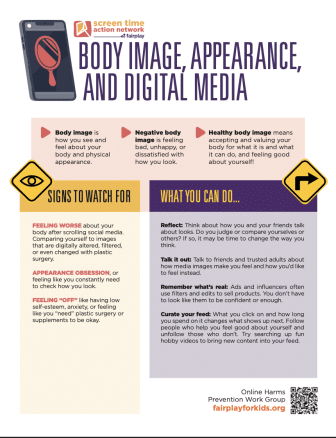
Body Image: Body image is how you see and feel about your body and physical appearance. Negative body image is feeling bad, unhappy, or dissatisfied with how you look. Healthy body image means accepting and valuing your body for what it is and what it can do, and feeling good about yourself!
Get Help And Learn More
- National Alliance for Eating Disorders — call 1-866-662-1235
- National Eating Disorders Association (NEDA): eating disorders prevention and treatment.
- The Beautywell Project: education materials with focus on media, appearance, racism, skin colorism.
- American Academy of Pediatrics: Social Media, Body Image & Self Esteem: What’s the Connection? (2025).
- Children and Screens: Social Media and Youth Body Image: What to Know and What to Do (2026).
- NEDA: Media and Your Body Image: What You Need to Know.
- Children and Screens: Digital Media and Youth Body Image (2025).
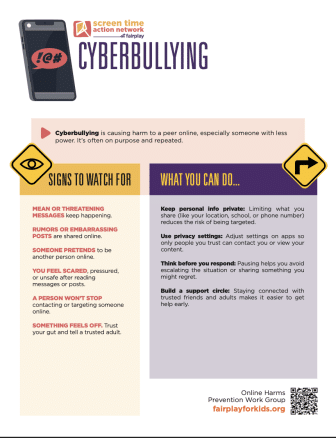
Cyberbullying: Cyberbullying is causing harm to a peer online, especially someone with less power. It’s often on purpose and repeated.
Get Help Now
- StopBullying.gov
- Crisis Text Line — text HOME or HOLA to 741741
- 988 Suicide & Crisis Lifeline — call or text 988 for Immediate emotional support for anyone in crisis or feeling overwhelmed (free, confidential, 24/7)
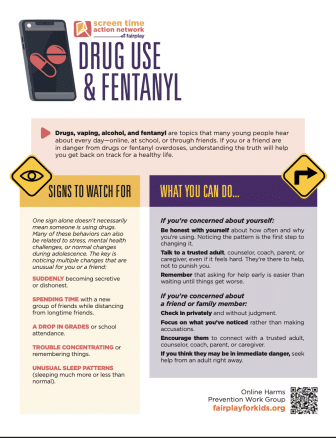
Drug Use and Fentanyl: Drugs, vaping, alcohol, and fentanyl are topics that many young people hear about every day—online, at school, or through friends. If you or a friend are in danger from drugs or fentanyl overdoses, understanding the truth will help you get back on track for a healthy life.
Get Help Now
- 988 Suicide & Crisis Lifeline — call or text 988 for immediate mental health or substance use crisis support (free, confidential, 24/7)
- YouthLine — call 1-877-968-8491 or text “teen2teen” to 839863 (free, confidential peer-to-peer support from trained teen volunteers)
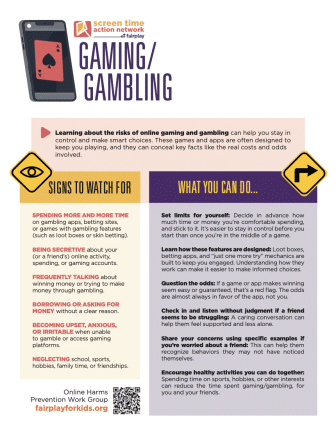
Gaming/Gambling: Learning about the risks of online gaming and gambling can help you stay in control and make smart choices. These games and apps are often designed to keep you playing, and they can conceal key facts like the real costs and odds involved.
Get Help Now
- National Problem Gambling Helpline — call or text 1-800-MY-RESET (1-800-697-3738) for free, confidential, 24/7 help for anyone concerned about their own gambling or someone else’s
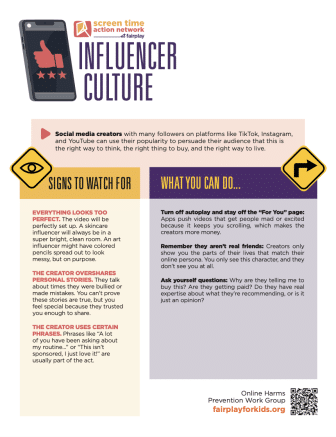
Influencer Culture: Social media creators with many followers on platforms like TikTok, Instagram, and YouTube can use their popularity to persuade their audience that this is the right way to think, the right thing to buy, and the right way to live.
Learn More about Influencer Culture:
- NAMLE (National Association for Media Literacy Education)
- News Literacy Project
- The Rise of Influencer Culture and Its Psychological, Social, and Behavioral Impact on Youth
- Effective influencer marketing: A social identity perspective
Social media influencers and followers’ conspicuous consumption: The mediation of fear - Cross-Cultural Analysis of Influencer Marketing: Meta-Analysis and Meta-Regression of Factors and Effects
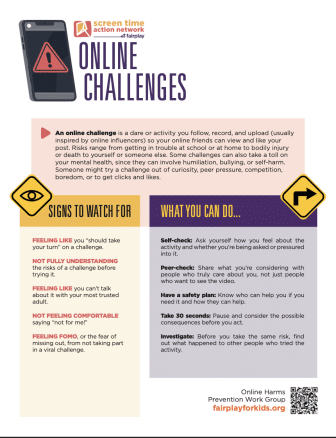
Online Challenges: An online challenge is a dare or activity you follow, record, and upload (usually inspired by online influencers) so your online friends can view and like your post. Risks range from getting in trouble at school or at home to bodily injury or death to yourself or someone else. Some challenges can also take a toll on your mental health, since they can involve humiliation, bullying, or self-harm. Someone might try a challenge out of curiosity, peer pressure, competition, boredom, or to get clicks and likes.
Learn More about Online Challenges
- YouthLine — call 1-877-968-8491 or text “teen2teen” to 839863 (free, confidential peer-to-peer support from trained teen volunteers)
- Learn more about the risks at erikscause.org
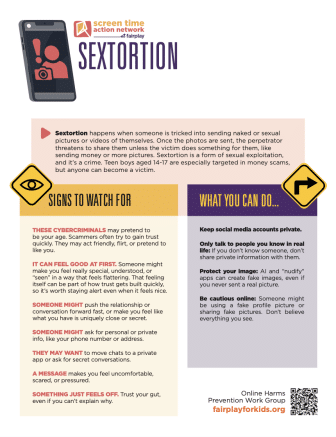
Online Sexual Exploitation: A range of crimes and activities involving the sexual abuse or exploitation of a child using technology. This could result in financial benefit to the perpetrator.
Learn More about Online Sexual Exploitation:
- CyberTipline (National Center for Missing & Exploited Children)
- Take It Down — helps get content removed from circulation
- FBI Sextortion Help
- Sextortion Education (NetSmartz)
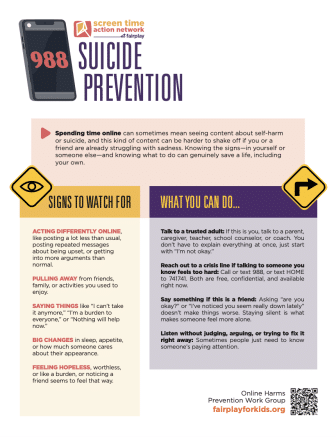
Suicide Prevention: Spending time online can sometimes mean seeing content about self-harm or suicide, and this kind of content can be harder to shake off if you or a friend are already struggling with sadness. Knowing the signs—in yourself or someone else—and knowing what to do can genuinely save a life, including your own.
Get Help Now
- 988 Suicide & Crisis Lifeline — call or text 988 for immediate mental health or substance use crisis support (free, confidential, 24/7)
- Crisis Text Line — text HOME or HOLA to 741741
- The Trevor Project — call 1-866-488-7386 or text START to 678-678 (for LGBTQ+ young people)
- YouthLine — call 1-877-968-8491 or text “teen2teen” to 839863 (free, confidential peer-to-peer support from trained teen volunteers)
- CONTROLLING WHAT YOU SEE ONLINE
- IF YOU SEE WORRYING CONTENT ONLINE
- SUPPORTING SOMEONE WHO MIGHT BE AT RISK
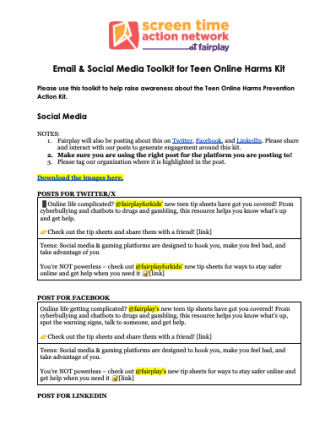
Want to help spread the word? Download our promotional toolkit and flyer today to help share these important materials!
Thanks to all who have contributed to the development and launch of the Action Kit!
Special appreciation to: Aarya Sivakumar, Cheryl Brown, Confidence Osein, Dawn Wible, Debby Jones, Jen Doty, Joann Bogard, Judy Rogg, Liana Vincent, Meg Stuhmer, Nicole Ooms, Randi Spiker, Tamara Sobel, and Vinaya Sivakumar

The Teen Online Harms Prevention Action Kit was brought to you by Fairplay’s Screen Time Action Network. Our Screen Time Action Network is a coalition of practitioners, educators, advocates, and parents working to promote a healthy childhood by reducing the amount of time kids spend with digital devices. Membership to our network is free. Join today to become a part of our community!